
Death by Misogyny
You may know many of these statistics. But have you joined the dots?

Content warning: misogynistic violence, medical negligence, death
I’ve dedicated my work to understanding misogyny for well over a decade. And I’m only just beginning to understand the depth of its effects on girls and women. We can get a feel for this by asking: how many of our deaths are the preventable, shameful results of this form of injustice? How many of our deaths, in other words, are deaths by misogyny?
Let me make it clear that misogyny doesn’t, in my book, just mean men hating women. There’s certainly plenty of that about, but misogyny goes far beyond this. Misogyny is best understood, I argue, as the hatred and hostility women face that serves a particular function: policing and enforcing patriarchal norms and expectations. Misogyny is the hatred she faces, not what he feels, in a slogan.
Thus understood, misogyny encompasses the indifference to our suffering that I’ve argued is cruel, even violent: we encounter and experience it as hostility as reasonable, cognizant women. Misogyny also encompasses the institutional betrayals and anti-women policies that make the world a hostile place for us to navigate. And it certainly includes the violence that is inflicted on us in a spirit of jealousy, revenge, and resentment.
If you understand misogyny in this systemic and structural way, then so many of the leading forms of untimely death that befall girls and women are due at least partly to misogyny. Let me count them. This list is of course not comprehensive, but it is notably broader than femicide as it is understood typically:
Familial and intimate partner homicide: every year, around 50 000 deaths occur worldwide due to familial and intimate partner homicide—overwhelmingly perpetrated by men. This translates to the death of a girl or woman by someone in her own family—including fathers as well as husbands—every ten minutes, which is the time it might take you to read this essay carefully. In the United States, three women are murdered by their current or former male intimate partner on a daily basis. And these deaths include family annihilation, where the perpetrator murders his female partner and their children. This is the most common type of mass homicide in this country. Overall, domestic and intimate partner violence account for around 60% of all female homicide victims: a male perpetrator known to the victim is responsible for 90% of such murders. And domestic and intimate partner violence is one of the leading causes of death for young women (aged 18-24) in the US, as well as a leading cause of severe injury for women more broadly.
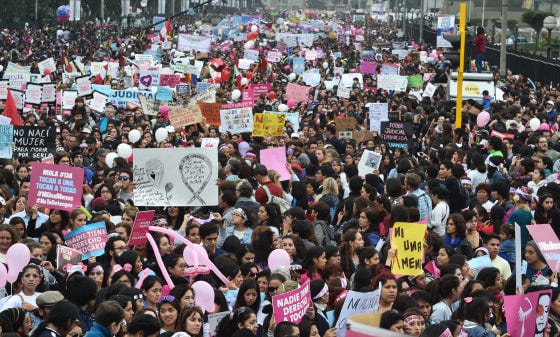
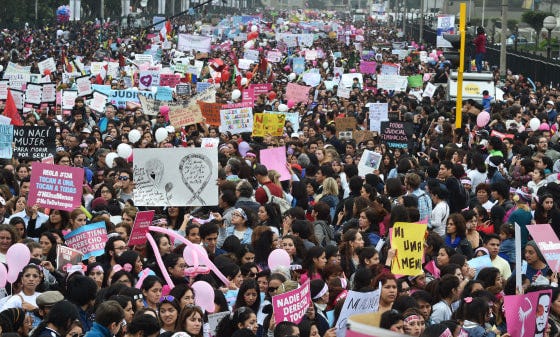
Image: From a Ni Una Menos (“not one woman less”) protest in Argentina
The violent control and neglect of pregnant and postpartum people: The leading cause of death in this demographic is, again, familial and intimate partner violence—exceeding all the other leading causes of maternal mortality more than twofold in one 2022 study. Maternal mortality from these other causes is still a massive problem worldwide and in the US specifically, where the issue is particularly acute for Black women, who suffer from at least three times the mortality rate as their white counterparts. And the 2022 Dobbs decision—which led to my decision to shout my own abortion and start this Substack newsletter—has of course made matters far worse, leading to massive further spikes in maternal mortality due to the denial and inaccessibility of adequate reproductive care in this country. Maternal mortality is now around one third worse in Republican-led states, according to a recent study. Women undergoing miscarriages are going septic in parking lots in red states like Texas, and—again—dying preventable, unforgivable deaths due to the dogged right-wing attempt to curtail our hard-won reproductive freedoms.
Medical negligence more broadly: As I wrote a few days ago, vaginal estrogen demonstrably saves lives for the substantial portion of women who suffer from recurrent UTIs, especially during perimenopause and beyond. And yet it’s not widely prescribed, despite this already being recommended on the strength of the existing evidence. What’s more: the news that it can prevent hospitalization, death, and sepsis among women in every age group did not get reported in the mainstream media. That story is representative of the extraordinary and disgraceful negligence of people with female-typical anatomy: the most famous example of this being the fact that the symptoms of a heart attack can be different for us, and are often missed in being misleadingly labelled “atypical.” (Nausea, shortness of breath, cold sweats, and pain in the back, neck, or jaw are some of these “atypical” but common symptoms among women.) Because of the relentless centering of male-typical experiences, women may be slower to recognize the signs of a heart attack, and therefore take longer to seek treatment on average. Still worse: we also face longer wait times and less thorough initial evaluations when we do get to the emergency room. (The same is true of people of color of every gender.)
Medical ignorance and indifference: The lack of research into medical problems that largely or paradigmatically affect girls and women is, again, a disgrace and a leading cause of preventable death by misogyny. The classic treatment of this issue is Caroline Criado Perez’s outstanding book, Invisible Women. One of the stories that gets to me the most that I shared in Entitled: uterine “failure” accounts for around four hundred deaths around the world daily, where pregnant patients are unable to give birth vaginally, due to weak contractions. They will then need an emergency C-section—which is risky and, in many contexts, simply unavailable. Imagine, then, the excitement of research that showed that patients with contractions too weak to allow them to give birth had more acid in their myometrial blood (located in the part of the uterus that initiates contractions). The researchers, Susan Wray and Eva Wiberg-Itzel, then conducted a randomized control trial of a possible treatment for uterine failure consisting of a cheap pantry staple: sodium bicarbonate, or baking soda. Those who did not receive this treatment were able to give birth vaginally in 67 percent of cases; for patients whose blood was made less acidic in this way, the number rose to 84 percent. That’s a 17% improvement in outcomes. Moreover, as the researchers noted, this treatment could potentially be made even more effective were it tailored to body weight and the amount of acid already in the patient’s blood, and administered in repeat doses. So, as Criado Perez writes, the significance of this research can hardly be overstated: it could transform healthcare outcomes for the tens of thousands of pregnant people annually. Yet the researchers’ application for funding to continue their research in low- and middle-income countries was turned down. The research was “not a high enough priority,” according to the British Medical Research Council.
Accidents that are fatal because the world is not designed for women: While we’re at it, as Perez discusses, one study showed that women who were wearing seat belts were 73% more likely to be seriously injured or die in a car accident than their male counterparts; another study showed that they were 17% more likely to be killed outright. Given that accidents are the fourth leading cause of death in the US, with car accidents being in turn the third most common kind of fatal accident (after falls and poisoning), this is a significant gender disparity. And, again, it’s completely needless. It holds largely because, until very recently, all crash test dummies were modeled on cis men, which ignores important differences in our fat distribution and skeletal structure. When female crash test dummies were introduced, they were built to be far lighter and shorter than most actual women. Maddeningly, these dummies were initially only positioned in the passenger seat.
Suicidality due to trauma and subsequent indifference: suicide is the second leading cause of death for women aged 15-24 in the US, as well as the third most common cause among women aged 25-34 and the fourth most for women aged 35-44. So it’s crucial to recognize that a major risk factor for dying by suicide is the trauma of familial, intimate partner, and sexual violence—all of which women, of course, suffer from disproportionately. Not only that, but we are fundamentally unhelped and unheld in the aftermath, which powerful testimony links to mental health crises. (Also, for the record: while it’s true that men die by suicide more often than women, women attempt suicide more frequently. That men’s attempts are more likely to lead to death is likely attributable largely to their higher rates of gun usage.) Again, this points to the misogyny that dogs women throughout our lives having potentially fatal consequences even when these deaths are superficially self-inflicted.
I’ve restricted myself just to deaths in which misogyny plays a major factor, and to obvious points and uncontroversial data. None of this does more than hint at the injury, illness, and pain—emotional and physical—that misogyny also causes. But I hope it is a useful lens for seeing in one glance the breadth and pervasiveness of the problem, as well as its profundity.
The problem is also, by some measures, getting worse—contrary to the toxic optimism of certain commentators. A 2023 report showed that young women (aged 25 to 34) in the US are now more likely to die than at any point since the 1960s, citing many of these factors. Moreover, had this mortality rate remained flat between 2000 and 2021, nearly 40 000 young women would still be alive. The report barely made a ripple, even in my progressive circles.
Who, then, is rising up in protest because of the needless, unjust deaths of girls and women? Who is declaring a crisis, let alone an epidemic? Only feminists are doing so at the margins, and at the expense of our own mainstream palatability and reach, much of the time. We are perceived, when we protest, as caterwauling and hysterical—or even crazy. These misogynistic perceptions prevent us from speaking out about the way misogyny represents a mortal danger. As I’ve often said: misogyny is a self-masking problem. Trying to draw attention to misogyny almost inevitably attracts more of it.
I refuse to be silent. I refuse to not be outraged. And I demand a safer, fairer world for girls and women everywhere.
"Moreover, had this mortality rate remained flat between 2000 and 2021, nearly 40 000 young women would still be alive...Who, then, is rising up in protest because of the needless, unjust deaths of girls and women? Who is declaring a crisis, let alone an epidemic?"
And meanwhile, men get to have a loneliness epidemic that makes all the headlines.
I find the work you are doing so inspiring and powerful. I admire your courage and thank you for validating so much of what so many of us absolutely know exists but is denied every time we bring it up because we are “too emotional .”