
How to Make a Good First Impression as a Woman
A new study reveals the unjust key: be thin.

A reminder: everyone is welcome here, but paid subscriptions are what enable me to spend the hours researching and writing this newsletter. So, if you can, please consider supporting my work in this way. Thanks!
Content warning: fatphobia
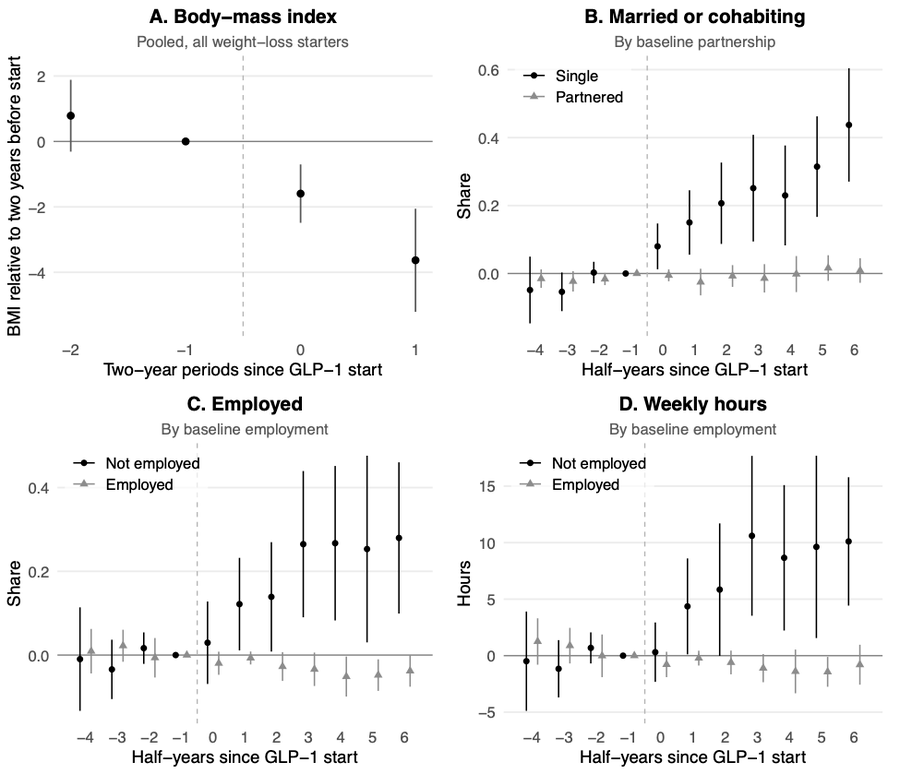
A little over a month ago, I received a text from a sociologist friend containing a Twitter link. The link connected to a working paper by the Harvard economist, Rebecca Diamond. She had studied employment and partnership outcomes for women who took a GLP-1 for weight loss, versus a comparable group of women who did not but wanted to start one. The women were matched for initial body mass, health, income, employment, partnership, and level of well-being. The results were stunning: after eighteen months or more, single women in the first group showed an increase in marriage and co-habitation rates of 29 percentage points. And employment among this group increased by 27 percentage points over the same time period. These effect sizes are so large that my sociologist friend was initially skeptical, and advised me to keep an eye on econ Twitter to see that the results held up before writing about this study.
Well, it seems they have, at least so far. And in part they reiterate what many of you know already from reading my work and the work of so many others: the penalty for fat women in employment and dating/marriage markets is nothing short of distressing. The so-called obesity penalty (so-called because the o-words are stigmatizing and pathologizing of people with larger bodies) for women is of course well-documented: study after study reveals it, and also shows it to have deleterious effects in health care and education. But what Diamond suggests is that these penalties may be especially severe in areas in which women have to make a good first impression. For while women who lost weight often went from single to partnered, and unemployed to employed, the study also found that such women didn’t enjoy upward mobility in existing jobs—or relationships, for that matter, given that existing partnerships didn’t dissolve at rates above the baseline.
The paper thus concludes:
The markets that respond are the ones where someone forms a fresh impression of a woman’s body weight: a prospective partner, or an employer considering an applicant who is not employed. For women, the arrangements that do not respond are the ones already in place, where any first impression occurred long ago and where weight is one characteristic embedded in a much richer stock of information. This pattern is consistent with an important part of the female obesity penalty operating as a first-impression discount. Reducing weight appears to remove part of that discount, but over the horizon I observe it does not raise income of the already employed or make women report feeling better off.
That points to a fascinating aspect of this study: the results cannot be explained by the women who lost weight feeling more confident or healthy, because on the whole they didn’t. As Diamond writes: “The broader pattern is difficult to reconcile with a general health, mood, or motivation channel. Self-rated health does not improve, and life satisfaction, loneliness and depression are largely flat or move in the wrong direction over the same horizon.” In other words, the women who lost weight felt no better and sometimes worse on average: the social gains they enjoyed were very likely due to the anti-fat bias that plagued them waning as their body shrank.
Diamond studied women and not men for two reasons: one, the “obesity” penalty is far more severe for women, as previous research has found repeatedly. Very thin women earn far more than fat ones, and the costs of being larger kick in for women at much lower levels of fatness. The evidence of an “obesity” penalty for men is mixed and inconsistent: it tends to afflict only very fat men, and is not even found in some studies. Two, as Diamond notes, women with larger bodies are using GLP-1s for weight loss at substantially higher rates compared with their male counterparts, leaving too few men to make for precise inter-group comparisons.
One question this study leaves us with is whether the women who lost weight are limited in terms of their upward economic mobility because they’ve largely broken through the anti-fat biases that would otherwise plague them, by giving their bosses ample other sources of evaluation, say. This is the interpretation of the data suggested by Diamond, but there is another possibility: that the women who lost weight on GLP-1s, whose starting BMI was 35 on average, have already been pegged as less intelligent and impressive and hardworking than their thinner counterparts. These disgust-based impressions are notoriously sticky and hard to shift, due to the way disgust tends to adhere obstinately to its object. So perhaps “once fat, always inferior” is part of the mechanism here, especially since weight loss has to some extent been devalued in the GLP-1 era—where people who lose large amounts of weight in a short time are suspected of taking the “easy way out” of a predicament they should extricate themselves from in the old-fashioned way. (I call this unfair and silly idea the “harder-better” fallacy.)
So it’s not clear to me that this study contains good news for fat women already satisfied with their employment situation, especially since massive wage gaps for fat and thin women obviate the idea that employment anti-fat bias operates purely at the hiring level. But it would take further research to distinguish between these two hypotheses.
All in all though, this research should make us sensitive to the magnitude of the “obesity” penalty for women, and the fact that shaming women who take GLP-1s for weight loss in the name of body liberation is no longer the move, if it ever was. (I say this as someone who’s been guilty of at least some mild scolding in this vein if not, I hope, outright shaming.) The fact is, women are smart: many have gleaned what this study shows already. If they want to form a partnership, or get a job, or secure more hours at their existing workplace, then their odds will be much better if they can achieve a smaller body size. Yes, plenty of fat women do fine just as they are: but we’d be lying if we said that you couldn’t improve your chances by shrinking yourself deliberately.
In the fatphobic world as it is currently, putting the onus on individual women to resist the lure of comparatively easy weight loss as it becomes increasingly accessible is hence yet another individualistic mandate when what is needed is a structural solution. And such a structural solution to systemic fatphobia is of course becoming increasingly elusive given these new medical technologies. In a nutshell: nobody should have to shrink themselves to improve their chances of getting a partner or a job. But women often do, so dismissing those who go down this road as vain or as sell-outs is monumentally unfair. It adds insult to social injury.
Diamond is sensitive in her paper—if not necessarily in her initial Twitter publicization of it—to this social injury, and to the fact that a fairly invasive medical intervention with significant costs and side effects is no substitute for justice. She writes in her conclusion:
These nonmedical returns [of weight loss by GLP-1s] raise distributional questions. Early adopters are disproportionately financially advantaged, and access is shaped by insurance coverage, out-of-pocket costs, and physician prescribing. If medical weight loss changes how women are treated in markets, then unequal access to the drugs may also shape who can avoid the social and economic penalties attached to body size. It is also unsettling to think about using medical treatment as a possible remedy for discrimination.
It’s not just unsettling, it’s positively dystopian: and much as a drug to make gay people straight would be no solution at all to rampant homophobia, the advent of GLP-1s is only going to make fatphobia a more potent cultural force and more difficult to resist at an individual level. (Needless to say, I hope, GLP-1s are also widely prescribed and taken for many medical conditions, including type 2 diabetes; nothing in this essay is a commentary on these important usages.) To make matters even worse, this non-solution to fatphobia is unevenly available too: many people don’t respond to GLP-1s with weight loss, can’t take these drugs in the first place, or can’t afford them even with their prices coming down now. Moreover, some women who have made embracing their body as it is a point of pride and power and integrity will find themselves increasingly marginalized and excluded and disadvantaged now, as they reject a means of getting ahead that nobody should have had to avail themselves of in the first place.
There’s a tragic story about the fat female body in our culture lurking in these new data. In many ways, it’s an old story. But it has been sharpened and dramatized by the GLP-1 era.
This point: "...nobody should have to shrink themselves to improve their chances of getting a partner or a job. But women often do, so dismissing those who go down this road as vain or as sell-outs is monumentally unfair. It adds insult to social injury." Clearly, a person in our world needs a job. More often than not, wants a partner. All I can think to ask is, are the jobs and the partners worth whatever you put yourself through to get them? Does the job, the relationship, last? What other penalties are there? Our culture is so appearance and age conscious----it's interesting that thinness in particular is so prized. "You can never be too thin or too rich." How old is that?
Fuck. I wish I could think of something more profound to say but "fuck" seems to cover it all.