
Looking the Wrong Way for the Gram
On turning yourself into part of the landscape at the expense of experiencing it

My family and I recently had the privilege of traveling to Switzerland. (I was due in Zürich for work and we tacked on a few days of vacation.) The landscape and the scenery were truly sublime in the sense of the early Enlightenment English philosopher Anthony Ashley-Cooper, the third Earl of Shaftesbury: “Space astonishes,” he wrote, speaking of something grander and vaster than the ordinary beauty of home. He was trying to capture the experience of none other than being in the Swiss Alps with his theorizing.
For our part, we explored the Bernese Oberland from our home base of an Airbnb in Lauterbrunnen, a picturesque but overtly touristy village at this time of the year in Switzerland. Our Swiss chalet looked out over a gorgeous valley—studded with other pleasingly homogeneous chalets and crowned with a white church steeple—and up into the craggy mountains down which spilled a narrow waterfall. We looked on with pleasure and reverence from our living room windows.
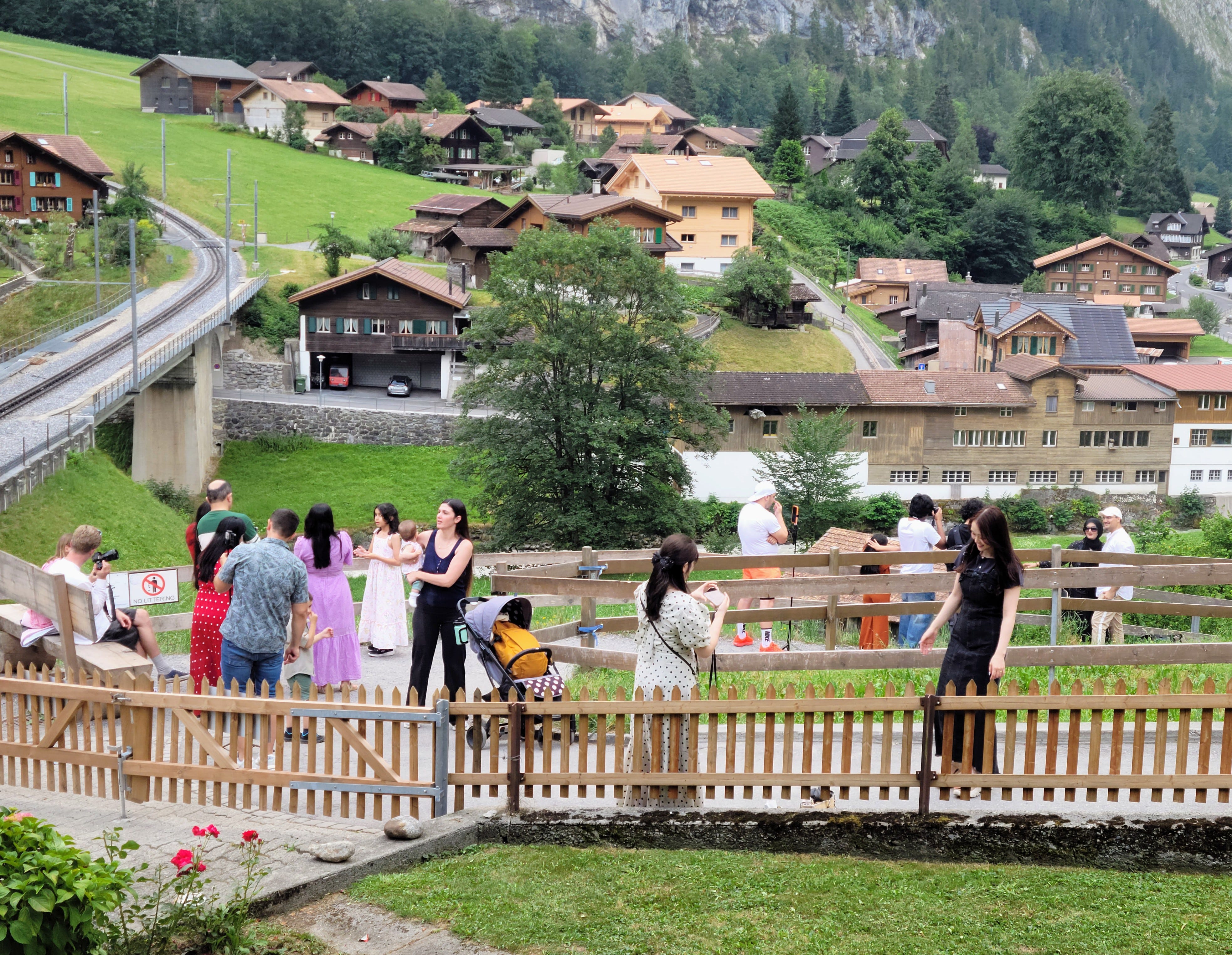
Unfortunately, so did a large gaggle of tourists: we were looking at a spot so popular that it had been marked on google maps as a selfie destination.
I initially thought of the irony of paying so much money to stay somewhere with a beautiful view only to be mostly looking at the people looking at the view we had been intending to relish. But to a sociological eye it was a fascinating scene; I now don’t regret getting some time to take in its dynamics.
Selfie-taking in this part of the world is a serious business, most likely because traveling here is extremely expensive. (I use “selfie” throughout as a synecdoche for all manner of self-portrait.) The typical subject of this exercise was a young woman, expertly made up and often boasting that telltale sign of juvenile cosmetic enhancement today: upturned lips that escaped their natural lip line, having been overplumped with filler. Occasionally she was beautifully outfitted in a summery dress and heels. But, more often, she kept it casual, as if about to go hiking in expensive but appropriate garb for the heatwave. She would tote along either a selfie stick, a companion, or a camera crew, depending on her level of dedication and privilege. She would join the queue to take not one or two but dozens of photos and videos of herself against the picturesque and—most importantly—recognizable landscape before yielding the adult peep board to the next comer. The aim, pretty clearly, was to post the results to Instagram and accumulate likes and envy—together, perhaps, with the follows that would contribute to passive income via affiliate links and branding deals in the case of the 1% on social media.
There was plenty not to criticize about this scene: Nobody seemed mean or pushy or competitive. Everyone waited their turn patiently, and in some cases smiled at each other and made small talk with queuing strangers who hailed from different parts of the world. Morale seemed uniformly high. The enthusiasm was genuine. But what was it for? What exactly was I witnessing?
It took me a while to pinpoint my discomfort relative to the usual barrage of somewhat tired complaints. My mind riffled through its store of ready-to-hand diagnoses: We don’t experience the world in an unmediated way anymore, but rather through our camera phones. Well, no shit: welcome to 2011. Women objectify themselves, particularly as young women, honing their bodies and self-presentation for the male gaze relentlessly. Well, yes and no: but these selfie-takers were performing for a predominantly female audience on Instagram, admittedly refracted through male-centric and heteronormative beauty standards. But what does that have to do with the landscape, as opposed to our much-bemoaned selfie culture generally? We live in a state of hyper-reality that perceives the simulcrum or the copy of the real thing as more real than the reality. But I have no evidence for this claim about what these selfie-takers were feeling.
And that’s when it hit me: something much simpler. These young women were not looking at the landscape at all. Most were literally looking the wrong way for Instagram, gazing up towards the busy street above in order to appear smilingly in the photo, gazing into the camera. When all their selfies had been taken, they turned tail and walked straight back up there to join the throngs in bars and restaurants. They were thereby unwittingly robbing themselves of the chance to experience first-hand the natural beauty and the charming village scene they were advertising to their followers. “Look at this amazing landscape I got to see!” declared the image they might have posted. But they never saw it at all with their own eyes in the moment. So focused were they on inserting themselves into the landscape and capturing the achievement of being there that they typically neglected to take a good look at where they had ended up in the world—at great effort and expense, most likely. The sublime was lost to the banality of self-centering; the possibility of real-life experience gave way to the falseness of nostalgia for a moment they had never actually experienced.
The gender dynamics of this are interesting and particularly noteworthy in this context: it was, as I say, overwhelmingly young women seeking this kind of social prestige via selfie. Even when she was traveling with a young man who seemed very likely to be her boyfriend, most of these couples took no photographs together. He was there to capture her: a beautiful and decorative and potentially recognizable person against a backdrop with these same qualities. Her body was ornamental and melded naturally with the landscape. Whereas when young men preen—as they undoubtedly do too—they tend to do it from their bedroom or their gym or their home gym. They thereby show their work in a way that is unapologetic. And they seek the kind of beauty that is more impressive than aesthetic. The point is to look strong, if not to actually be so. Their bodies become ornaments in looking like powerful instruments.
I want to close by making it clear that I am not hating on these young women. They were enjoying themselves and their lives and sometimes making a buck using the technologies available, as well as the resource that patriarchy has made their faces and bodies into. Good for them, for the most part. It is, as usual, possible to criticize the late-stage capitalist game while being kind about its players. What is striking to me is partly how easily this problem might be remedied: by remembering to look both ways before you post to your grid or your stories or your TikTok. Or take your selfies and then put your phone in your pocket and turn the fuck around. Then linger. Look around you.
Reader, you might be wondering what it looked like too. You know I took a photo.
And OK fine: a little treat for paid subscribers, because who am I not to participate? What am I if not a content creator? So here I am with my daughter enjoying this green screen.
Keep reading with a 7-day free trial
Subscribe to More to Hate to keep reading this post and get 7 days of free access to the full post archives.