
When You’re Called Crazy
Reflecting on one of the most powerful weapons of misogyny

I have been called crazy exactly once by a person in my own circles. A notoriously peevish and petty professor asked his followers on Twitter for stories about me, to see if “I’m as crazy as my colleagues say.” Given that I had just criticized this man for going after one of my graduate students publicly, it was pretty clearly a vindictive Tweet, and of course nothing came of it. (I hazard that my lovely colleagues would report that I am collegial and unremarkable, even boringly normal, to work with.)
It’s striking, however, that I still remember this incident years later. It filled me briefly with a sense of panic. There’s something about that particular accusation—“crazy”—that feels especially threatening, especially as a woman. It’s telling that this last clause almost didn’t feel necessary to write here: the people called “crazy” are predominantly women, and it does us disproportionate damage to be subject to such charges.
What is someone saying when they call you crazy? They’re saying you’re so unreliable and erratic in your habits of mind and your behavior that you should be written off as a person. They are saying that you are a threat, a liability, and a danger to yourself and others. The application of the term “crazy,” when it gets uptake, can serve to cancel a person in one fell swoop. The term is not just descriptive of an unspecified kind of mental illness and deviant behavior: it functions as a pejorative, and also a kind of warning label. Calling you crazy tells others not to tangle with you. You are at best to be managed, and likely simply avoided.
But the term “crazy” can also serve to justify violence: arrests, incarceration, institutionalization, and forced sterilization are the fates that have often befallen people tarnished with this label. If you’re crazy, it’s for your own good and vital for the protection of others.
Disability scholars have done fascinating work on reclaiming the terms “mad” and “madness,” which are linked to the controversial possibility of embracing rather than trying to assuage certain forms of mental illness. But I don’t know of any efforts to do this with the word “crazy.” I suspect it is a term that really cannot be revived—you can’t breathe new life into a term that marks you for social death, to use Orlando Patterson’s notion. When pop culture flirts with any ambivalence about craziness, it’s usually in a circumscribed form: we are crazily in love or are crazy about someone or something. The primary acceptable way of losing our minds and acting erratically is in service of heteronormatively-sanctioned romantic narratives. And there’s always a danger of being written off in the process—as a crazy ex, a crazy stalker, a crazy fan, and so on.
It’s not surprising that the term “crazy” is a powerful tool of gaslighting, a phenomenon that has been brilliantly analyzed by the philosopher Kate Abramson. In her landmark paper on this phenomenon, several of her signature examples involve an accusation of craziness. And that makes sense: on my subsequent analysis, which owes much to her account but departs from it in various ways, we can define gaslighting as a process that functions to make someone feel fundamentally defective in some way for states of mind to which she is actually entitled. She is in pain but treated as if she is a malingerer; she knows what is going on but is treated as if she is out of touch with reality; she is having a normal reaction but is treated as overly emotional or cruelly unforgiving. Or, importantly for my purposes here, she is saying or doing just about anything we don’t like and is written off as crazy. Craziness is pretty much the ultimate defect in theoretical and practical rationality.
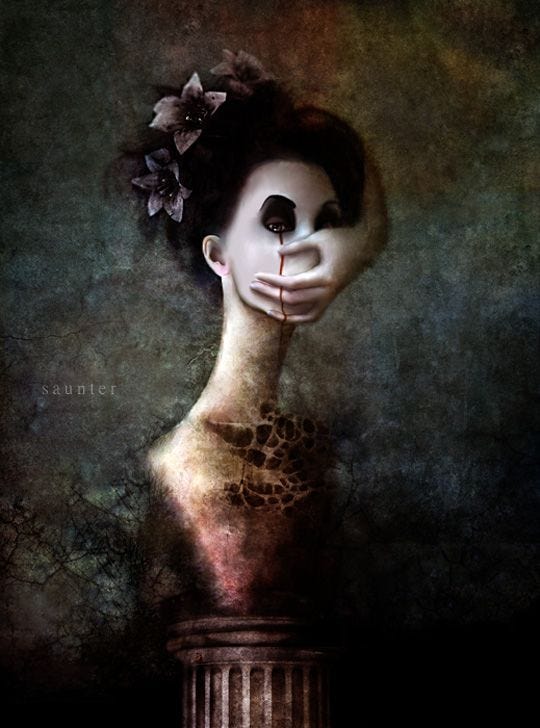
That’s part of the insidious power of the label “crazy.” It’s not just that it depicts people as fundamentally flawed in a very general way—as bad, mad, and dangerous to be around. It’s also that more or less any assertion or behavior deemed anomalous can get you slapped with the label. The standard refrain of the men who gaslight and abuse women is thus “crazy bitch,” as work by the sociologist Paige Sweet has demonstrated. And other gender-marginalized people meet with similar forms of gaslighting and subsequent social dismissal: trans people are currently fighting a major political battle to not be labeled crazy (or delusional) for simply being who they are and demanding social recognition.
I don’t advocate reclaiming the term “crazy,” but I do wonder what is lost when we are so intent on not only being but proving ourselves sane as women and as feminists. For my own part, I live with a constant low-grade anxiety that makes me quite deliberate, almost performative, in my demonstrations of sanity. In my day to day life, I am careful to seem calm, cooperative, and not angry. If my writing often has a more intense edge to it, perhaps that is because it serves as an outlet. But even so: there are very strict limits to what I will allow myself to say, for reputational as well as ethical and professional reasons. Philosophy, with its rather dogged emphasis on the value of rationality, would have little time for anyone who didn’t perform self-mastery in her writing.
But the truth is that that has always struck me as a serious cost. Some of the most brilliant, creative people are a little bit crazy—or at least a little wild, to use the more polite alternative I have offered my six-year-old daughter. (This substitute, while imperfect, is also very necessary: kids may call anything that surprises them crazy otherwise, and the term is obviously often problematic in its ableist and misogynistic connotations.) The wild ones are often interesting in a way that I cannot be, in letting themselves think and create in jagged rather than straight lines. I plod from A to B to C or dutifully join the dots. They zoom through the alphabet and draw on the blank side of the paper. They, and sometimes they alone, can surprise us.
I think we need to make space for women to seem, and perhaps be, at least a little crazy. It’s interesting that it is mostly in music, that artistic genre most divorced from the dictates of coherence, that craziness gets a little airtime, a little play, a little love. Who hasn’t sung along to the earworm of a Gnarls Barkly song that begins with self-interrogation of his own craziness and ends with a shrug towards the collective. “But maybe I’m crazy/ Maybe you’re crazy/ Maybe we’re crazy/ Probably.”
But the 4/4 beat is regimented and relentless and the song doesn’t feature so much as a key change. It’s craziness within the narrowest of musical parameters—parameters which are always tight in any non-experimental genre. And, crucially, the song is sung in a man’s voice. As a woman, I can only sing along so loudly.
Much to reflect upon, here.
I am thinking about a student I taught this term who let me know early on (I invite all my students to tell me about anything they think I should know that might interfere with or complicate their ability to fully engage in my course) that she had Borderline Personality Disorder. In the last week of term she was hospitalized due to a mental health crisis. Her final essay came in 2 days before my grade submission deadline (past, even, the extension we had agreed upon) with the disclaimer at the top of page one (erratically formatted) that she had written it in an hour during a manic episode. I wrote back and encouraged her to request a medical incomplete for the course, which I would support. Then I read the essay. It was strikingly insightful, original, bringing two unlikely works together to gain a broader systemic understanding. It bore the mark of her very distinctive approach to reading and interpreting texts. Remarkable. And unlike her other written work, not composed with the kind of tortured misguided effort to impress me with arch, stilted prose. So sometimes literal “craziness” can bring exceptional clarity.
In my experience calling women “crazy” is most commonly a way to dismiss and invalidate them when they are actually speaking truth to power - calling men out on their shit. (Like your colleague in fact.)
We dismiss so-called “crazy” women at our collective peril.
You aren’t crazy, but the people running the current U.S. government certainly appear to be. It sounds as if the professor who wrongly called you “crazy” was using a defense mechanism against you based on pure misogyny.