
On Being the Cassandra
An interview with the creators of the extraordinary podcast that teaches us new lessons about sexual abuse, the power of adults over children, and what it means to advocate for victims.

Content warning: child sexual abuse
You’ve heard me rave about it before: Adults in the Room, a new podcast that delves into a decades-long question about child sexual abuse and the cover-ups at a large public high school in Seattle. The investigative reporter, Isolde Raftery, was a senior at Garfield High in 1999 when she first heard the rumors: Tom Hudson, a popular science teacher and the leader of an outdoor education program, was grooming and abusing boys in his orbit. Raftery investigated with her best friend, Ella Hushagen, and published a story alluding to the allegations—without naming Mr. Hudson—in the student newspaper which they both worked on. When Mr. Hudson was subsequently placed on leave, pending a formal investigation into his conduct, it ultimately led to a tragic chain of events that Isolde and Ella were blamed for.
More than twenty-five years later, they decided to re-investigate the case, and also delved into the misconduct of two other teachers at their high school—Dave Ehrich and Dr. Al Jones, the school principal. The results are a stunning achievement in storytelling and narrative journalism. And they reveal so much about what it means to advocate for the victims of sexual abuse, along with what these victims suffer.
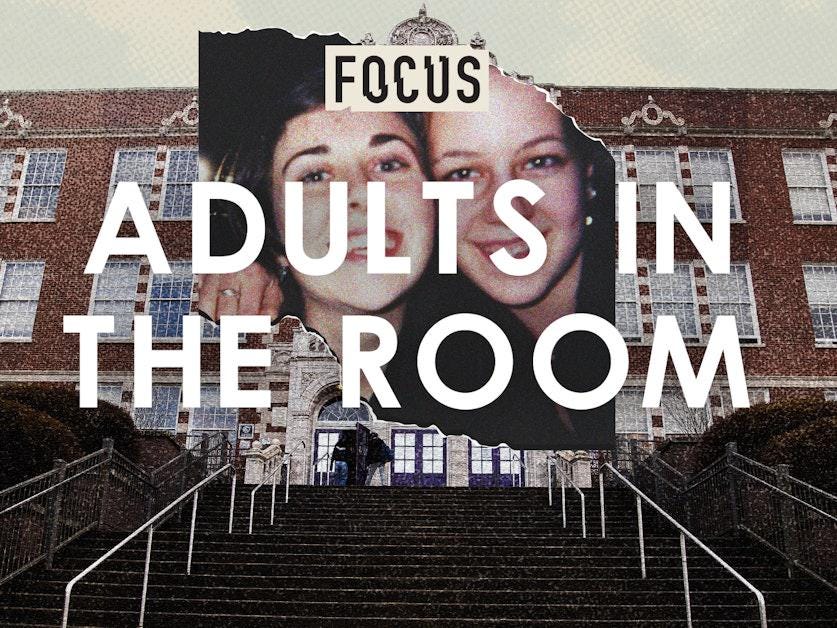
I was delighted to get to interview Isolde and the podcast’s editor, Jeannie Yandel, to ask them about what it’s been like to work on this runaway hit podcast, which has now had well over a million downloads, and is provoking such important discussions. What follows is a transcript of our conversation, lightly edited for length and clarity. We have kept spoilers to a minimum.
Kate: Isolde, I saw your role as a teen as being a Cassandra in this story, and I found your moral clarity really extraordinary because, you know, we graduated at the same time. I’m class of 2000 and I was privy to similar problems at my high school. But I would never have been able to do what you did: to know that this was wrong and to know that it demanded journalistic investigation and a story exploring the issues that it raised ethically. What do you think enabled you to have that kind of clarity and courage at such a young age?
Isolde: I’m so glad you asked this, because I’ve never really been able to talk about it before. My aunt Mary Raftery was an investigative journalist. And she was looking into the church’s abuses in Ireland. Even though Mary lived there, I was very close to her, and I saw her pretty frequently. She even took me on some reporting trips with her. So I had a role model of someone who went up against her own society. In Ireland, it was very Catholic back when she was doing these exposés. You had to have a priest as a reference for any job. So that’s the world she was operating in. And so I saw that courage.
The second person who influenced me is my French grandmother who was involved in D-Day and getting the pathways to the beaches then. My great-grandfather was a naval officer and my grandmother spoke English. So she translated and interpreted for the Americans and for my great-grandfather. Growing up, I knew about how courageous she was. And she always said, you’ll never know you have courage until you’re in the moment. And I would say to her, I will be brave. I will always be brave. And she said, you don’t know that. You don’t know until you’re in the moment.
And then there’s my mom. When we lived in Paris—she’s French—she had a camera that she would take around with us. And every time she saw police officers being racist, she would take photos and she would confront them. And she actually intervened as members of skinhead gangs attacked a Black man on the subway. She went and confronted these guys. I was on the opposite bay watching. So I had these three examples of women who intervened. And when the moment arose for me, I thought, I can’t not intervene. I truly remember thinking: I can’t be the woman who doesn’t have courage.
Kate: Wow, that’s incredible. So I come up in my work, oftentimes, against this question that I find really haunting: is it lack of belief or is it not caring about the victims of abuse? And I found in your story elements of both. But there were certainly examples of willful denial of people’s experiences that seemed very hard to deny and also a degree of believing a victim’s story, but not caring enough about what he or she had experienced. What’s your perspective on that now, having told this story?
Isolde: The way Dave Ehrich, my journalism teacher, put it was that girls wanted it. They were complicit and they were sexually interested in their teachers and they would come on to them. And then ultimately—I actually just read this in my diary a few days ago when I was fact-checking something—he said that the male teacher pushes back, and the girl keeps pushing, and he keeps pushing back. And finally, he just gives in. And I do think that is how many people see it with girls: they have crushes on the men and are young temptresses. I think that is the narrative. With the men who prey on boys sexually, I think it can feel different—people see it as less natural partly due to homophobia. Whereas young girls being with older men, that’s a story as old as time.
So, yes: I think some people don’t care about sexual abuse, and I think they don’t think it really matters for girls in particular, and I think they don’t think it’s traumatic. It is traumatic. Each one of our survivors has told us how it has impacted them well into their thirties. So, yeah, I think there is a total lack of caring for some people. I think they’re also okay with a few casualties. They think there are just a few. But there are almost always more than a few: it’s like a smattering of stars in the night sky, but there are so many more we can’t see due to the clouds and the light pollution and the sheer distance. Tom Hudson may have had as many as fifty victims, according to one estimate we heard recently.
Kate: Wow. And that’s really helpful confirmation of this devastating sense that I’ve developed over the years. It’s devastating partly because the corrective to not believing someone is, we improve our epistemic practices, we get better at realizing that, when people tell us about sexual assault and abuse, they are overwhelmingly telling the truth—because what’s the incentive to lie? But if people don’t care, then I do not know, as a philosopher, the fix for that.
Jeannie: The other thing I was thinking about is that, all of the times when you see that happening, you understand what the calculus is, even if you yourself have never been through it. Early on in this process, Isolde, you talked often about Dave Ehrich and dismissing your own experiences of him sexually harassing you. That is a huge part of it: we are all conditioned in many ways to want to not make a big deal about stuff that is a very big fucking deal.
Kate: That is so sharp, Jeannie: in a nutshell it’s why I do what I do, because I think we are all socialized to minimize and to feel a sense of moral smallness about the stories that almost all girls and women, unfortunately, have to share. Part of the minimization is that you can almost feel safer, I think, telling yourself it wasn’t anything, than realizing a predator could do almost anything in that small room or on that camping trip, or realizing that there aren’t those boundaries that you absolutely rely on, especially as a young person who’s vulnerable. It can be easier to say, “Perhaps I misunderstood,” than to admit that there is no innocent explanation for that behavior and that means you are in danger.
That brings me to my next question. I feel like there is this myth sometimes that men—and your story is of three male predators—simply can’t help themselves. This is somehow just a sexual impulse that they truly can’t control. But what really struck me in your reporting is how careful these men were. They walk up to a line and push it.
Isolde: Yes, they have a playbook. One thing I have been hearing from survivors is that their abuser was so confident, it almost seemed like he was following a script. One of the men even admitted to having a playbook. The playbook is, first, you test. Then you push a boundary. Maybe you have a sexual conversation. You just see. Then you move on to: how much can I touch? And one of the survivors we interviewed, Jason Fox, called it a thousand boundaries that were crossed before you get to the final threshold. You don’t start with the big thing. You start with tiny little things.
And there’s another thing, too: these kids, I think most of them knew that it wasn’t quite right. Some of them knew it was illegal, but they’d all been groomed to believe that they were in a personal relationship with their abuser, that what they had was special. The disclosure that has happened with all of them to me has been a realization that they were not the only victims, which has been a source of a lot of anger. They were sort of like, “Wait, I thought I was the special one.” And even though they thought that was gross with the benefit of hindsight, it was realizing there were others that made them want to speak up. They realize they’re not alone and they better speak up because healing often happens collectively. And so that has been fascinating to realize. One, they realized they fell prey to a playbook. Two, I think they believed, until more recently, that they fell prey to someone who loved them. And now they realized that they were actually a means to an end. And deliberately exploited.
Kate: Something your podcast brought out for me is just how vulnerable students are to their teachers. It’s not just opportunity. It’s that you have this person who, as a student, wants to be seen, wants to be recognized, maybe made to feel special. There was a quote from the survivor Christina Mitchell that really struck me. She said, to paraphrase slightly: “It’s easy to take advantage of a young person. They have all these issues and problems. The teacher can come to the rescue with all these things. And naturally, the student will gravitate to them with that in mind. So the teacher can take advantage of the student’s disadvantage.” This is obviously something we have grappled with in the case of priests and other religious leaders. But I don’t know that we’ve grappled with this fully in the case of teachers.
Isolde: Schools are unfortunately a buffet for potential abusers and students are so vulnerable to sexual abuse and exploitation from certain predators who choose a teaching career quite deliberately with that in mind. They’re a small minority of teachers—maybe 2 or 3%—but they’re very deliberate about it and the students are so vulnerable. And there are some students who are even more vulnerable. One of the things I’ve noticed is almost all the survivors I’ve spoken to tend to have had trouble of some kind—or maybe they were shy or didn’t have a lot of friends. There’s just a sort of list of things that makes them even more vulnerable. And even looking at myself with Dave Ehrich, I was a kid who wanted so badly to please everybody. I come from a hyper-intellectual family, and I just wanted to please all my teachers and be the A+ student. So, yeah, people prey on that too.
Kate: That sounds very familiar. Having studied misogyny and sexual abuse and harassment and assault for a long time, I don’t know that there’s much to be done about the wrongdoers, the perpetrators. It’s a question above my pay grade, but the idea that at least some are really committed to predation just strikes me as fundamentally correct. But it’s at the level of the third parties that I always feel like we have a real “in”. I wonder if you can talk to me about the role of your podcast in empowering third parties to not just be a bystander and to be complicit in the way that so many people are. Because I hear from victim after victim that the second party’s wrongdoing was terrible, but what was even worse was the indifference of the third parties and institutions who just washed their hands of it.
Jeannie: That third party question is so huge. I have seen people in real time deny what they’re seeing in front of their own faces, particularly when it comes to sexual assault. And this is, again, the conditioning that happens: warning signs are going off and many people shut down. They become like possums and just play dead, even when they could be an active bystander. Frankly, I don’t think that we talk enough about the moral responsibility of a bystander. These conversations are always about the perpetrator and the victim. We never talk about the third party and what role they might play here. On the flipside, people who actually intervene are treated as heroes. And that’s because it’s rare.
Isolde: A victim told us recently: “There will always be Toms, but there do not have to always be Toms able to prey on dozens of children. That only happens due to systemic failure, including the failure of all the adults around. No one took accountability and no one did anything. They literally all failed us. There were no adults in the room.”
That says so much, doesn’t it? I’m sending so much gratitude to Isolde, Jeannie, as well as Ella, and the whole team at KOUW for this incredible podcast. Please do listen if you have the bandwidth.
Wow. I thought about the dilemma, what do you do about the people who don’t care?
I think the people who do care have to care more, louder, and get in the faces of the ones who don’t. The active bystanders have to be more active, and to hell with all the people who DGAF about victims.
The more evidence given about this horrendous issue the better. And I deeply appreciate learning about this important podcast. 🙏🏼
This issue (adult sexual abuse of students) is especially rampant in music schools, conservatories and summer music programs. These institutions put hagiographic cultural fencing around studio teachers who have unique, high pressure power over students. Administration then refuses to take complaints seriously because these studio faculty are a.) the gateway to the student’s entire career (it’s a guild) and b.) are the basis of the institution’s prestige. This new documentary is naming the problem rampant in this high stakes arena…and currently touring, in search of distribution.
And no, I have zero connection to this project…but know the core story driving the project via an associate of Lara’s brother, who is himself a 1st-tier American musician and teacher.
https://youtu.be/CMxv1Phxxw4?si=h2wj93gq2auBpjBv