
When Men Are Tender
Patriarchy deprives men of one of life’s greatest joys

Animals have always naturally gravitated to my husband. I have photos of him under endless cats, dogs, and also reciprocating scritchies with several horses. He knows just how to interact with a creature that is ever-so-slightly nervous: there’s a subtle openness of body language that accompanies leaving them nicely alone to come to him on their own terms, followed by a gentleness that reassures them: you are safe with me.
So it wasn’t surprising to me when Daniel was the first person on whose lap our new kittens climbed, and the person they chose to spend their first night sleeping on. Luna curled up on Daniel’s shoulder, and then his pillow; Kuiper slept on his chest without moving until the morning.
Many animals are, of course, scared of boys and men. This isn’t because men are bigger or have deeper voices on average. It’s because, when animals are abused, it’s typically by a boy or man. Animals are smart; animals remember.
Patriarchy oppresses girls, women, non-binary people, and arguably non-human animals too. And, as Robin Dembroff recently argued here, it also hurts boys and men badly. My “yes and” point to their brilliant article: convincing a group of people to be violent rather than tender, as a condition of their “real” membership in that class, is one of the weirdest, grossest tricks. And it serves a clear purpose: fueling the military industrial complex with cheap, expendable, uncomplaining labor. Make the willingness to wage war a prerequisite for being a “real man” or an “alpha” and you suddenly have a source of soldiers both tireless and inexhaustible. The wars include not only the ones that are named, but also the ongoing war to control and dominate women.
What a colossal shame. What a disaster for our prospects for peace and love and humane cooperation. The desire to dominate people and places is responsible for such needless, pointless destruction.
I often write about the damage men do to girls and women, as well as other gender-marginalized people, due to patriarchy. This will always be my major focus. But it feels necessary from time to time to note a complementary truth: patriarchy deprives boys and men of so much—whimsy, community, intimacy, and the capacity to be tender.
I was thinking about this partly because I recently became the last millennial woman on earth to finish HBO’s hit series, Heated Rivalry, about two queer male hockey players (spoiler alert) forming a sexual relationship and ultimately falling in love with each other. It’s brilliant not because toxic masculinity is entirely absent from the script: Heated Rivalry is not the stuff of pure untrammeled social fantasy. Rather, toxic masculinity is a very peripheral force that is gently dislodged in favor of tenderness during the series. Shane and Ilya start by calling each other “boring” and “an asshole” between the passionate and sweet sexual encounters that ultimately bring them together. They find tenderness and intimacy through sex, thereby puncturing the myth that truly consensual sexual activity will be a head-scratching challenge for men in our society. And the love that they eventually find is punctuated by a gentle playfulness that comes to replace their rivalrous ribbing. When Ilya calls Shane boring now, it’s a joke on Ilya and his fascination with his great love. When Shane calls Ilya an asshole, it’s in mutual recognition of how—in classic romance style—Ilya’s tender interior was carefully hidden.
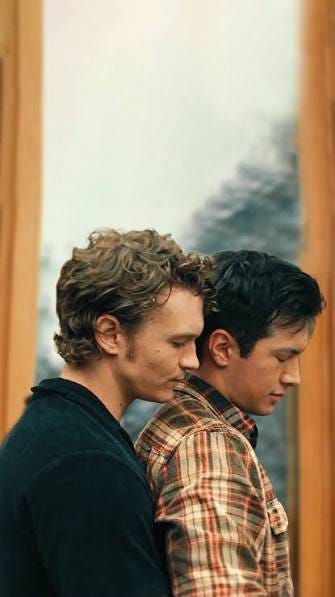
This romantic trope has been mistaken for proof that “nice guys finish last,” as Brooklyn Dodgers manager Leo Durocher had it in 1946. Women really want an asshole, who is rude, domineering, or even violent, goes the thought. But it’s a silly misunderstanding because the fantasy is just this: that underneath the asshole, there’s a tender, gentle man waiting to be made manifest.
It may or may not be true. And, in truth, it matters little: truly asshole-ish behavior is morally disqualifying. Nobody should be trying to scratch a surface that might well be all there is. And even if the gruffness is just a facade, it is not the job of women or other romantic interests to carefully unearth the true interior. Relationships should not be a work of characterological archeology.
Men, including straight men, could choose to be tender in the first place. They would thereby have so much to gain in terms of their own attractiveness as well as a capacity for emotional intimacy that is geared to give as well as receive, and to provide care as well as asking for it by showing vulnerability. Showing vulnerability is important, of course, but so is the strength and bandwidth to hold the emotions of other people. Otherwise the capacities in question may become troublingly asymmetrical and truncated. A man who can receive tenderness but not give it is like the boy in that nightmare children’s tale, The Giving Tree: asking and wheedling and getting, and never reciprocating care for other people or creatures or parts of nature.
I am not saying boys and men have nothing to lose by making the leap to tenderness. They will be giving up the ability to impress some of their peers, and they may even be made fun of. There are sacrifices involved in giving care too, as well as a lot of labor—and some of this is a slog, as almost any woman can tell you. But what they have to gain is incredibly real and important too and, from where I’m sitting, alluring: Love. Community. Connection. Kittens.
I think the most mothers who have little boys find them to be very sweet and often gentle. They are fed messages to toughen up. I believe this is difficult for many boys for puberty. Hormones make it easier. The counter programming really needs to step up an early adolescence, so they can maintain open hearts.
"...characterological archeology" a perfect definition of your point.